As you know, I am trying to make the point that a Dive Master Trainee program in the tropics ticks almost all, if not all, boxes to deal successfully with some sort of life crisis, or at least an “is this all there is” feeling that will not go away. So let me first describe to you what this program actually feels like, what people actually do and learn. You can find dry descriptions on any website of any dive school, but here I want to give you a different perspective.
Chances are that you have been diving already on a holiday, so you know a bit about it already. If not, let me explain shortly: recreational diving in warm water has nothing to do with images of people in dive suits staying hours underwater in diving locks with funny helium voices or locked in cages looking at big sharks. All nonsense. Diving in warm water is relaxed swimming in an aquarium while you can breath under water and you can go to the surface any time you like. You do not need to be a good swimmer, you do not need to be super fit to go diving. If you can swim and are in a fairly reasonable condition, you can enjoy diving. Diving is flying under water while being in a completely new world. Diving in warm water is completely safe, absolutely not scary, and minimally physically challenging.
Learning how to dive is also not difficult. In fact, in three days with four dives you can have your certificate to go diving with a buddy all by yourself; the Open Water course. I know many of you have done this, probably. Many of you might have also done a two-day Advanced Course, where you have learned to go a bit deeper, worked on your buoyancy, and maybe to navigate more effectively, or been diving at night. Not many of you will have done the last recreational diving course, the three-day Rescue Course, where you learn how to take care of other divers. This last course is usually the favourite of students and instructors alike, because it brings together everything you have learned in a meaningful, challenging and fun way. So, in a week or so you can be at this level, even if you have never been diving.
After this, you go on to become a Divemaster Trainee, a DMT. This is the program I am convinced is the perfect way to deal with a crisis of meaning in our lives, because it ticks all the boxes I described above. I realise you are probably not that interested in actually working in diving (but you never know), but what I am saying is that this program itself is very interesting for you.
A Divemaster Trainee program teaches people the knowledge, skills and attitudes to take the responsibility to lead dives with certified divers and assist instructors at teaching diving. Usually, there is one person who is the mentor of all trainees and who is responsible for the whole program. All trainees are also part of the team and go diving daily together, or help instructors teaching courses.
To acquire the skills you need to be a Dive Master takes time and practice. You are either diving with your mentor to learn skills, diving with an instructor to assist and learn how to deal with divers, or you are diving with other students for the experience and fun. You will spend a lot of time on the boat, under water, or interacting with people of all ages and all nationalities.
A good dive school has a clear program to help you with this, and someone responsible for this program. Usually, this is a two-week or a three-week schedule that is repeated in sequence, or monthly, or whatever. You will be expected to join activities from this schedule when you are able, or when you are ready, or when you feel like it. A good dive school will give you at least a month, but preferably two or even three months to do this. You will need this time, because you are not here to become a dive master as quickly (and cheaply) as possible. For you, the road is the goal. Besides, you probably need some time as well to do some online-work or whatever.
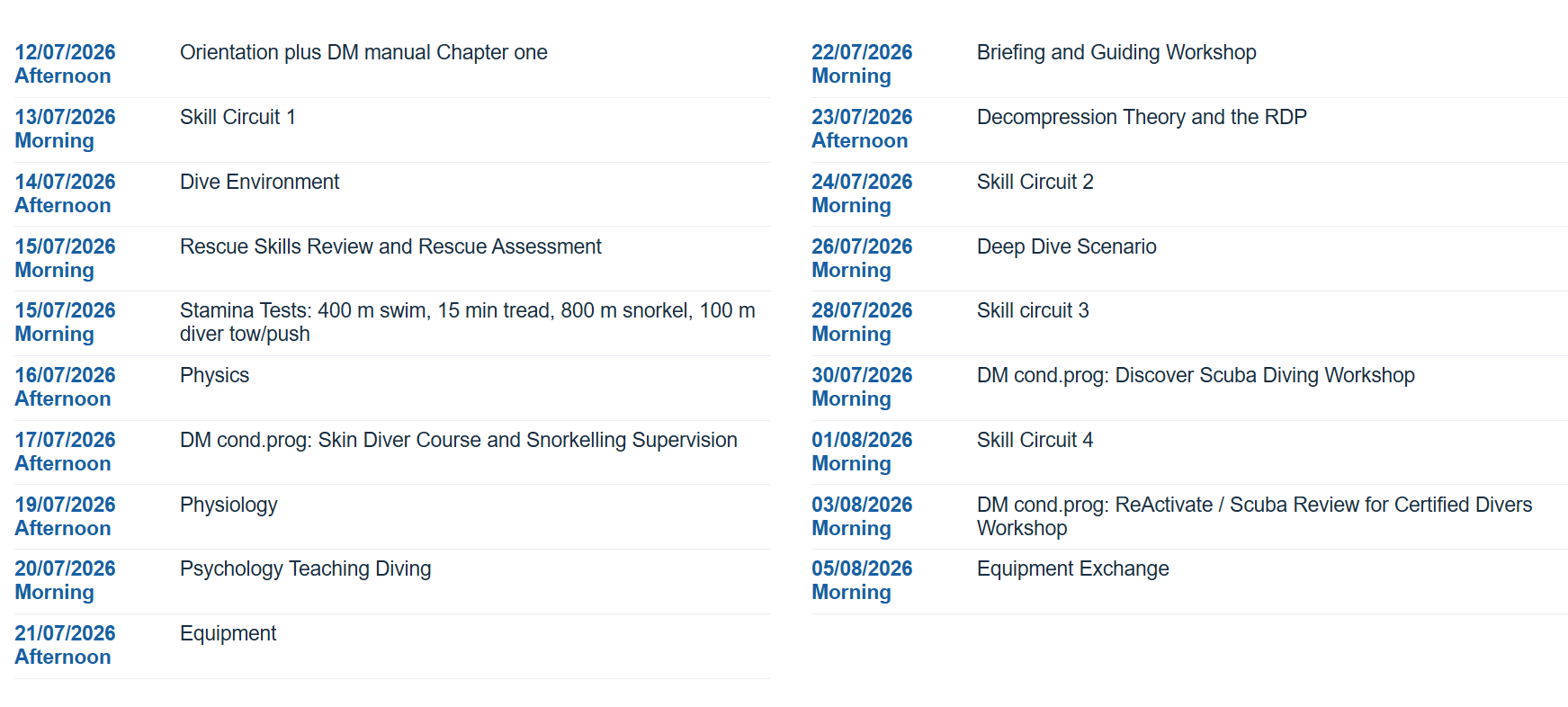
As soon as you are comfortable under water and have done some workshops, you will be needed to assist instructors with courses, usually try dives, open water, or advanced open water courses. You will be an active member of the team as soon as possible. Let’s look at a typical two-week Dive Master Trainee schedule.Now, you will not do this schedule as it is. If you stay two months, the schedule will come along three times, so you can pick and choose. This way, you have time to assist with courses and have time off or whatever you need to do. Usually a schedule is in half days, so one part is for diving, and one part is for land-based activities. Usually, the theory (physics, physiology, equipment, decompression theory and dive environment) are optional: if you prefer to do this on-line and alone, or at home, that is up to you.
A skill circuit is simply a session in a pool or shallow water where you learn how to demonstrate and evaluate all skills that are taught on an open water course; clearing a mask, using an alternative air source, recovering your regulator, etc.
A Typical Day of a Dive Master Trainee in the Tropics.
You wake up in the morning and you probably have a shower, jump on your bike or walk to the dive shop or to a coffee shop close to it. You are in the middle of assisting an open water course with your favourite instructor, Robin, who has worked for a few years at the dive shop and you worked before with him (or her). You are meeting up at the boat, the large wooden boat that can take 40 students, waiting at the pier. It is sunny and there is a bit of wind, but no large waves. Robin tells you what you two will be doing: you have the same four students as yesterday, one from Germany, one French and one Canadian. They all can speak English a bit, and Robin speaks a bit of French, while you speak a bit of German, so that is one reason why you are there. You know them already, you have been diving with them yesterday at dive 1 and dive 2 from their open water course, so you know what to expect. You will be helping them set up their equipment, doing the buddy checks. You will listen to the briefing Robin gives, and then you will help them jump in the water, Robin will go first. Because one of the Germans is still a bit nervous, you decide that you will be the buddy of that student.
You will be repeating a few skills under water: how to recover a regulator and how to clear your mask. You are responsible for keeping the students organised, and you will be demonstrating these skills as a reminder. You have done three skill circuits already and looked these specific skills up yesterday, so you feel confident enough to do this. After this, you all will go for a dive. Robin will be at the front, and you will be with your student at the back. You will be first to help them with small problems, like buoyancy, and you will keep them all together.
There are a few other Divemaster Trainees on the boat, and you all drink a coffee together. Divemaster Trainees come from all walks of life, from many different countries, they usually came for a break with their old life, to get some distance and perspective, and actually have time enough to do that. (It is amazing how easy it is to connect and learn from these people: I have listened for hours to software developers, construction workers, airline pilots, ex-convicts, star-chefs, ex-army guys, you name it, sooner or later they have turned up. And you all connect, because we all know why we are there.)
When all students have arrived, you guide yours to their gear. Usually it takes a while to get to the first dive site, and students always like to ask people like you first instead of their busy instructor, so you get to know them and you can help them to get ready and relax. They usually ask about things that stress them: fish, their gear, and they always ask you where you are from and how long you have been here and what you are doing. Again, it is very easy to connect, and have real conversations with them. It is amazing how much they tell you, how open and personal it can become. That might be because you took them to a new and potentially stressful environment, so they are in a very new and good mood, and because you have proven they can trust you. And it probably helps as well that they know they will leave soon and probably will never see you again. I really know of no other situation, no other environment where this is so simple and easy to do.
During the dive, under water, you need to relax and keep your breathing under perfect control. You will learn to do this really quickly, because with your breath you control your buoyancy and your own relaxation. All the time under water, you will be perfectly aware of your breathing pattern. You will help your students to relax as well, point out interesting things, and you will be the first person to help solving small problems, while the instructor has the final responsibility, like a captain and you being the co-pilot.
After the dives, back on land, more often than not you will have a drink or share a meal with your students with your fellow dive master trainees. You will not make it too late, because tomorrow you will have a workshop: search and recovery under water at sea.
Everything you do will be evaluated on clear criteria and signed off by your mentor or a dive instructor, so you will get clear feedback. When you have done all you need to do, and probably more, you will be certified as a Divemaster by the international dive agency of your shop, usually PADI or SSI. You will be a world-wide recognised dive professional from that moment.