For all these reasons I started a program called: A Second Look: Perspective Change and Personal Reorientation Through Dive Training. It is a normal Divemaster traineeship with an addition of simple tried-and-tested psychological exercises under supervision of the Divemaster trainee mentor that help you to benefit maximally from your experiences. It is not therapy, but a way to make you realise what you are doing, what you are learning and how you are changing.
These are very basic psychological tools, and they fit the program naturally. We look at personality not as a label, but as a pattern, and we compare how you see yourself with how others actually see you. We look at cultural differences, so you become aware that things can be done very differently, without either way being right or wrong. We work with the three cognitive biases that get in your way the most when you are trying to change. And we use Rational Emotive Behaviour Therapy, a simple, well-tested technique, to give you real insight into why you react to your environment the way you do, and to give you a concrete way to change that.
We ask everyone in the group to keep what is shared there private — this is not a rule we can enforce, only a request, and almost everyone respects it, because they are sharing their own story too. The mentor steers the group gently away from anything too personal, too raw, or too easy to regret sharing with people you will still be diving with next week.
More importantly: a mentor who runs this part of the program gets basic training to recognise the difference between a normal, sometimes emotional moment of insight — which this program is full of, and something that goes beyond it: real trauma, something that clearly needs more than a group and a good conversation. When a mentor sees that line, they stop the activity, gently, right there, and state plainly that this deserves a professional, not us. That is not us ignoring you. That is us knowing exactly where our competence ends.
Personality; The Big Five
Personality is a stable pattern of how someone thinks, feels, and behaves across different situations and over years. It is not a mood, which is short-term. People tend to describe personality as types: he or she is a “typical extrovert”. This is not how it works at all in reality. After decades of research, it turned out that people actually are different from each other on five scales, and on each scale you can score from low to high. Also, each scale is independent of the others, so knowing your score on one scale says nothing about your score on the other scales.
Self-assessment and 360 degrees feedback
Let’s first look at what the five scales are:
Openness — how much you're drawn to new ideas, new experiences, and abstract thinking, versus how much you prefer the familiar, the concrete, and the tried-and-tested. High scorers get restless without novelty; they like art, ideas, travel, and questioning how things work. Low scorers aren't less intelligent — they just find comfort and reliability in what's known, and don't feel a strong pull toward the untested.
Conscientiousness — how organised, disciplined, and goal-directed you are, versus how spontaneous and flexible. High scorers plan ahead, follow through, and keep their environment in order. Low scorers work more in bursts, tolerate mess and uncertainty better, and can be more adaptable when plans fall apart — but can also struggle with follow-through and deadlines.
Extraversion — where you get your energy from. High scorers are recharged by people, activity, and stimulation — being around others feels good, and quiet or solitude can start to feel draining. Low scorers recharge in the opposite direction — social interaction costs them energy, and solitude restores it. This isn't about being shy or confident; a low scorer can be perfectly comfortable socially and still find it tiring.
Agreeableness — how much you prioritise harmony and cooperation versus how much you're willing to create friction to say what you actually think. High scorers are warm, trusting, and avoid conflict — they'll often go along with something rather than cause tension. Low scorers are more sceptical, blunt, and comfortable disagreeing openly.
Neuroticism — how easily you're pulled into stress, worry, or negative emotion, versus how stable and even-keeled you stay under pressure. High scorers feel things more intensely and are more reactive to setbacks — this isn't weakness, it's a nervous system that runs "hotter." Low scorers stay calmer under the same pressure, though that can sometimes look like being less affected by things that should matter to them.
To be absolutely clear: no score is "good" or "bad", they are just descriptions.
We have a tool online available for you where you can score yourself on these five dimensions. This will give you a bit of insight into how you tend to react to your environment. More interesting is the have a look how people actually see you, so if your idea about yourself lines up with the idea people around you have of you. So after a month in the program, once people actually know you, we ask a few of them — your mentor, a couple of fellow trainees — to fill out the same test about you (you do the same for them of course). This gives you a 360 degrees view: how you see yourself, next to how you actually come across to people who have seen you being happy, tired, in control and irritated for a month. Again, this is not to judge you at all, but only to give you insight in yourself.
Here is an example taken from the tool you will use:
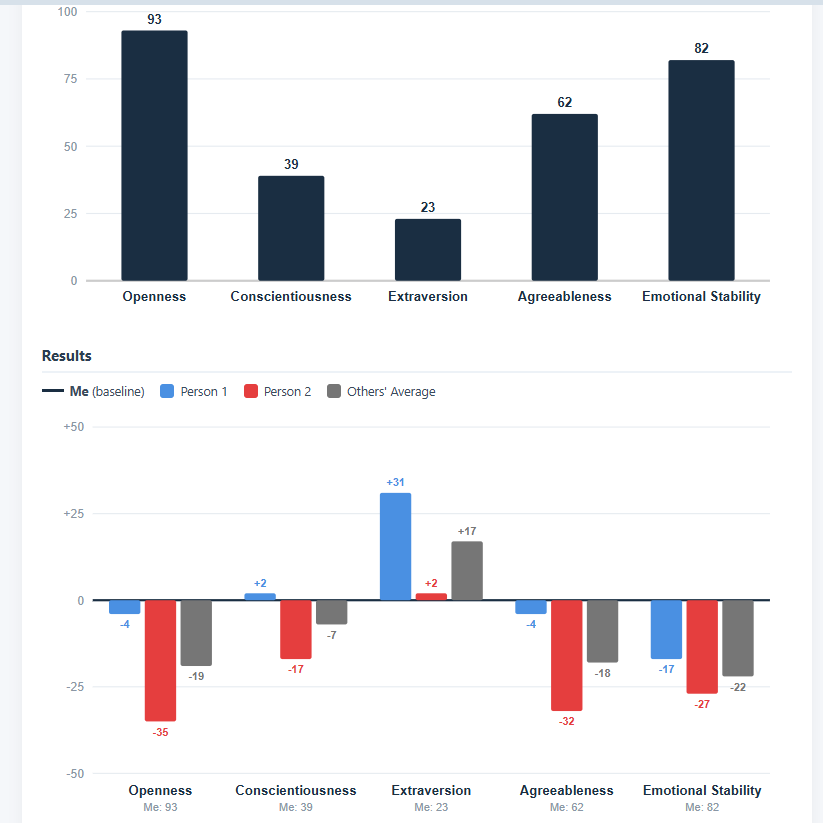
These are just made-up data, but they show what information this tool gives. As you can see, I have a much more positive view of myself than others have. I am not as open, conscientious, agreeable, or emotionally stable as I think I am...others see that differently. I am also much more extraverted than I think I am myself. Especially in emotional stability the two others agree between them that I am much less stable than I think I am. Interesting information, that we can explore further in real life.
We will explore this together with you in a personal session, and actually use this information in the program.
Personality as behaviour: The Big Five in real life
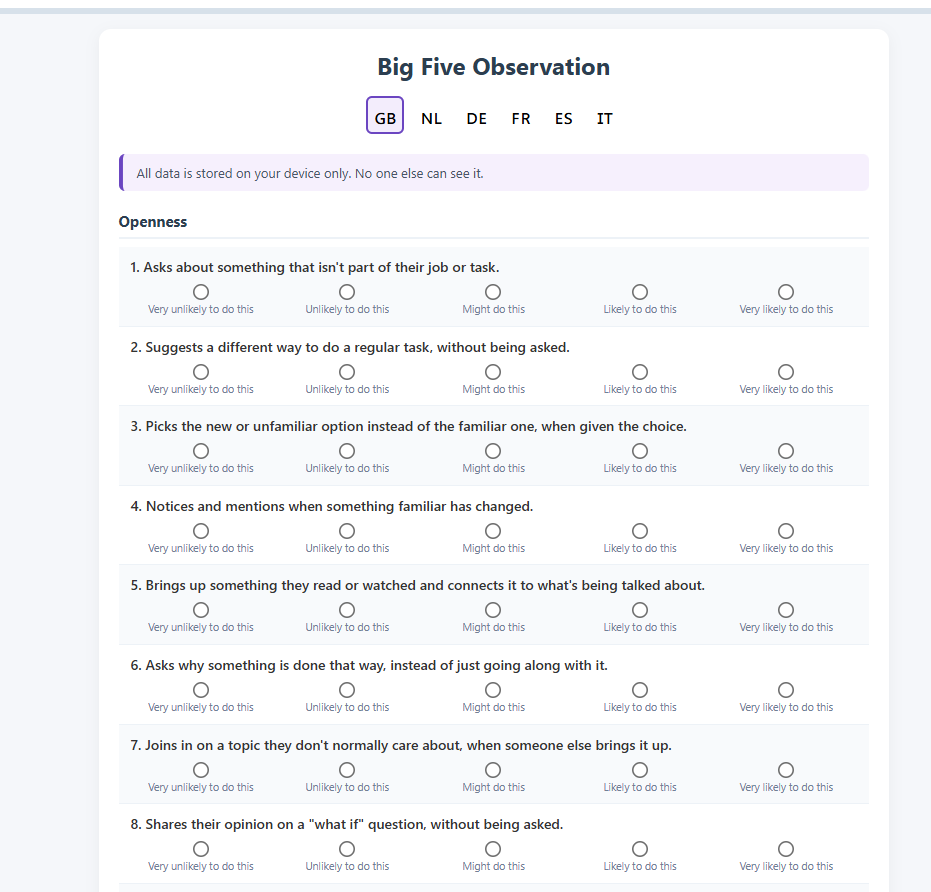
It is also informative to actually try and see if you can see these individual difference in the way people do things, how they behave. This will make you much better to “read” people, which will make it in turn easier and more rewarding to interact and work with other people. You will have a tool you can use that lists behaviours per scale. You will take the time to just actually step back and just look at people in a systematic way, which will be surprisingly fun and informative.
Personality: the Gap
Here we are going to reflect on the personality data. After a few weeks, to have filled in questionnaires for yourself and others, and others have filled them in for you. You have also been able to actually systematically observed individual differences. You will start to explore the gap between what we all think about ourselves and what others think of us. We will do that with photo exercise below, and also in a discussion with the mentor and one or two significant others.
We will make use of insights by cognitive bias research and Rational Emotional Behaviour Therapy.
Cultural Differences
An important part of the success of this program is the opportunity to interact with people from different cultures, and also to live in a different culture under controlled circumstances. We have developed a tool you can use so you can become aware of these differences, and use them to reflect on your own situation.
In the 1960s and 70s, research across dozens of countries showed that cultures differ consistently along a handful of measurable dimensions — not vague stereotypes but patterns that actually show up in the data, country after country, decade after decade. These dimensions matter here:
Power Distance. How much people accept a boss having power over them. High: people obey, no pushback. Low: people expect to be asked, and bosses earn respect instead of assuming it.
Individualism. Whether people put themselves first or put the group first. High: personal goals and opinions come first. Low: family, team, or community comes first, even over what you personally want.
Gender Differences. How strictly a culture assigns "tough and competitive" to men and "caring and gentle" to women. High: men compete and achieve, women nurture, and stepping outside that gets noticed. Low: gender differences are small
Need for Certainty. How much people need a fixed plan and one right way to do things before they feel okay. High: people want clear rules and get anxious without them. Low: people are fine improvising in uncertainty.
We have built a simple comparison chart, where you can pick your own country as a baseline (that is the way we all see it, we cannot help that) and put it next to the country you're training in, or your students' countries, or your fellow trainees', up to four at once, and see the actual numbers laid out side by side.
Every one of those scores describes something you picked up decades ago, long before you were old enough to question any of it, in the same way you picked up your language, simply by being surrounded by it for years with nothing else to compare it against, and never once being told that any of it was a choice rather than just how things are. Now, you will have to chance to step back and get some perspective.
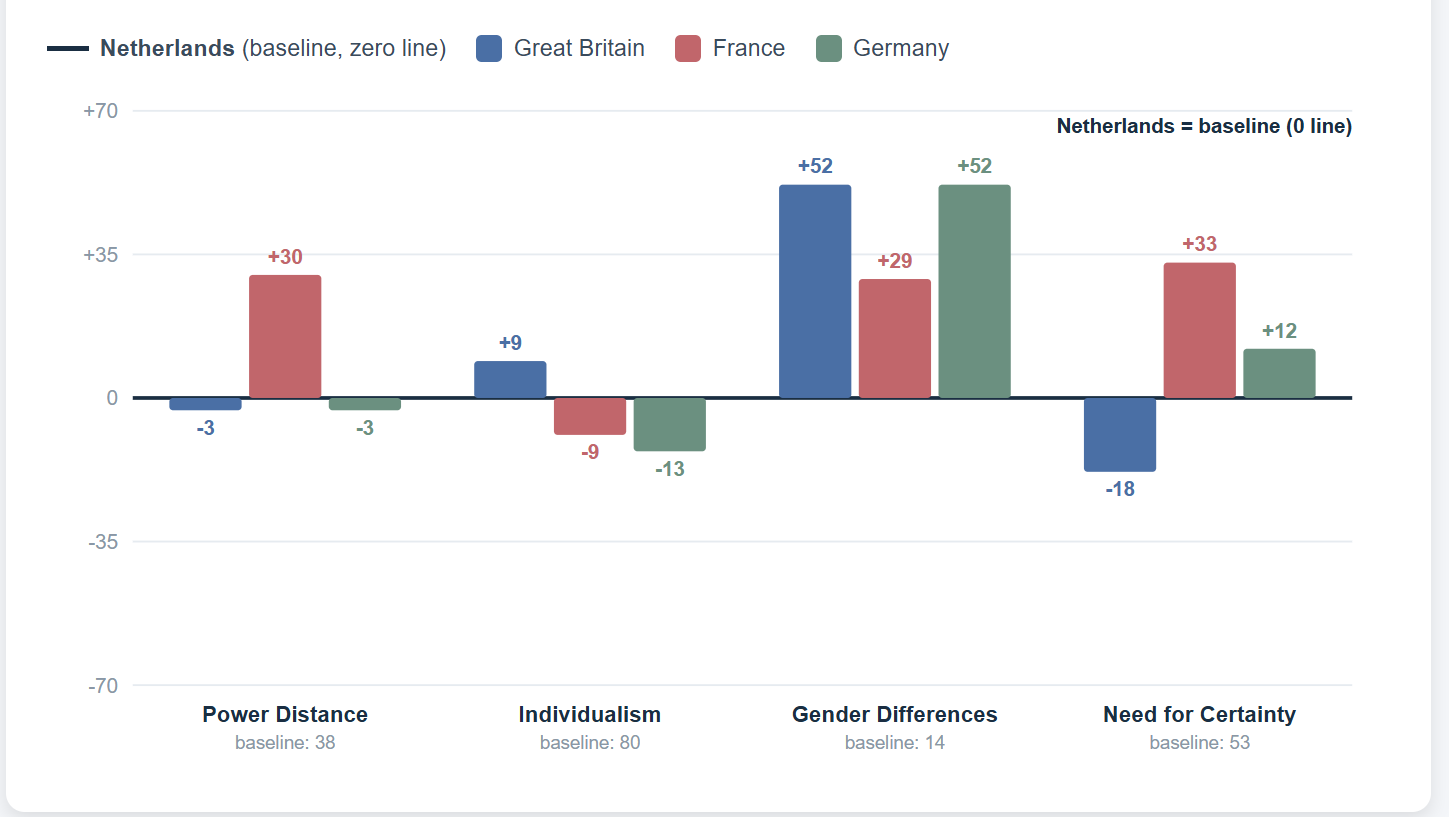
These are real data. I am Dutch, so I chose the Netherlands as base line. What is obvious right away, is that in my Dutch culture, gender differences are much less pronounced than in the rest of the countries. Dutch culture also doesn’t have that much need for certainty… but Great Britain needs even less.
Also this information you can use to get more to know about yourself and get some more perspective, and we do this in the program as well.
Cognitive Biases
We all interpret the world around us and make up stories about how things are and what our role is in that. More often than not, the stories are not “true”, or even the most logical, effective, of pleasant ones for us. The problem is, we tell ourselves these stories to simplify things, to make them understandable: the world is way too complicated to really understand everything. In fact, even you yourself are far too complicated to understand yourself. But you make up stories, automatically, so you can deal with this. We are hardly aware that we even do this, we truly believe we experience the world “as it is”. But that is NEVER true.
You see, truth does not really matter for the survival machine your brain actually is. In fact, if the truth gets in the way of surviving, or is far too costly to discover, just let it be. The truth can be far too depressing to cope with directly, or is just irrelevant. Fooling yourself to feel at least OK about yourself and taking quick decisions that are half-decent most of the time paid off, and that is what causes these biases.
So things can go wrong, and they often do. The only way to work with this is try to become aware of the fact that you ARE telling stories so you can tell yourself you understand things. The next step is then simply to change the stories that make you unhappy and hamper your development.
The first way to do this is to look at Cognitive Biases. A cognitive bias is a systematic error in thinking that leads people to misinterpret information and make irrational judgments. These biases shape how individuals perceive reality and can cause different people to interpret the same facts differently. You probably have seen lists of them, proving that you are not so smart as you might think you are. We will work with the three most relevant to self-improvement in the Divemaster Trainee environment.
Confirmation Bias
You always look for evidence that proves you are right, and ignore evidence that shows you might be wrong.
We have the tendency to notice things that prove our stories, and just ignore or reconstruct that things that do not fit. I will prove to you right now that you are doing it as we speak.
I will give you a row of numbers, and you must guess the rule behind them. Then you must ask a number to check if you have the right rule. Here we go.
2 4 8 16 32
Now, any normal person would say: “64”, because you notice things just double all the time. And in fact, 64 is correct, yes, that can be the next number. So you say: you just double the number! No, you are wrong, that is NOT the rule. By asking me if 64 is OK, you cannot check that rule. You need to ask a number that is NOT a double. You should not confirm, but trying to disprove. You should have asked “63?” or something. If I say no, you can be a little more sure that doubling is the rule. But in fact, I say: “yes, 63 is OK”. Now you know for sure, absolutely sure, that rule is NOT doubling. Notice that asking 64 does not give you that information at all. (the rule is in fact: the next number must be larger, that is all. I tricked you, like the world does all the time).
This bias is extremely dangerous, because it gives you confidence that is based on nothing. This bias can make even very experienced pilots try to land on a taxiway full of waiting air planes. Have a look at this fascinating video showing this:
https://youtu.be/bLEGir9lzBo?t=705
Now, if confirmation bias can make extremely experienced and extremely well-trained pilots explain away all facts that a taxi-way does not even look like a runway (on purpose, I might add), what chance do we have in normal life in the real complicated world? Not much, but we have to try to at least be aware that the story that we are telling ourselves might not be true, and that we perhaps can check a bit better.
You see this is nothing vague or mystical.
The point here is that you always need to ask yourself:
“What if my view of the world or myself isn't completely accurate?”
And then start actively looking for evidence that contradicts your usual story. To be absolutely clear: the goal isn't to “think positive”. The goal is to try to get a more accurate picture of yourself in your environment by trying to pay attention to things that are against your ideas. If you believe “I'm not good with people,” you will naturally notice things that “prove” this: you notice the awkward conversations and ignore the times people enjoyed talking with you. If you believe “I'm stuck in my life,” you'll pay attention to all the things that “prove” you are stuck and disregard opportunities you might have to change. This is where the Big Five observation of others comes in handy: they give you a better, more objective view of what you actually do and how others react to you. In the program, we will teach you to look for things that disprove your idea about yourself.
Fundamental attribution error
Your successes are because you are competent and your fails are bad luck, but the successes of others were just good luck, and their fails because of incompetence.
When we try to do something ourselves, we are fully aware of our intentions. We judge the result against those intentions. If you fail, at least your intentions were good, and it was probably a lot bad luck that you did not succeed. When we look at others, we have no idea about their intentions. We cannot look inside their heads, so we just look at the results of the behaviour. If they fail, it was because they did something wrong. So we judge ourselves on intentions, but we judge others on results only. And that makes us think that if we do not succeed, it was mainly bad luck, but when others fail, it is because they are idiots who do not know what they are doing.
Now, it itself this is a very useful bias, because it makes you feel good about yourself, even if you fail. And you know, you may even be right (sometimes). This is all not to say that you actually cannot be an expert on some matters, and actually know better. But this bias make you think that you are always right. And the price you pay for this is that you are less likely to learn from your mistakes (it was just bad luck, nothing to learn really) and that you do not give other people credit enough to be able to work with them and more importantly, learn from their mistakes (they have proven they are idiots after all). Keep this up long enough, and you end up with the idea you are only at least half-competent person in a world of fools.
Putting you in a new environment where there are other people who actually do know better gives you the opportunity to catch that bias and give you back the opportunity to experience the pleasure of working with and learning from other people.
Spotlight Effect
Grossly overestimating how much other people notice, judge or remember what you do.
As a human being, having access to all those things that go on in your head, you are pretty self-obsessed. You need to be to survive. But the mistake is here that you assume that people are just as obsessed as you are with you. They are not. They are also obsessed with themselves and have no time and no interest in taking notice of you and the details about you. Yes, you are a grown-up and you know this, but the point is you probably still massively overestimate how much attention actually pay to you.
There are fascinating experiments where people are interacting with a sales person, are distracted for a few seconds, and in those few seconds the sales person switches with someone else, with different hair, different clothes. Most people do not even notice anything.
https://youtu.be/VkrrVozZR2c?t=110
And they rightly should not notice these things. Our capacity to process information is limited, and we cannot simply pay attention to every single detail in every single situation. The point here is that there is a good chance you might be torturing yourself with thoughts about what people think of you, what you said and done...when they are in fact not thinking about you at all, let alone about what you have said and done. They are far too busy worrying themselves about what others think of them...
There is one more amusing demonstration of the spotlight effect, and it features the very uncool Barry Manilow. Researchers made undergraduates wear a t-shirt with a big photo of Barry Manilow. Barry Manilow was pre-tested to be embarrassing for that population, he was not exactly a cool campus icon in the late '90s. A student wearing the shirt would then walk into a room with a few other students, and after a few minutes, they left again. And here comes the trick.
The t-shirt wearer was asked to guess what percentage of people in the room would be able to say who was on their shirt, and of course the people in the room asked if they actually noticed anything.
The ones with Barry on their T-shirt thought that about half would have noticed, while actually only a quarter noticed. So: you are wearing the most uncool shirt ever, and only about 25% actually noticed this. A sobering thought.
In our program, we will show you the spotlight bias in action, so you can actually stop tormenting yourself about your image.
Rational Emotive Behaviour Therapy
There is one more tool in the program, and it ties the others together: Rational Emotive Behaviour Therapy, or REBT. The idea behind it is simple, and you have already felt it in the biases above: our reactions, thoughts and emotions are not based on things happening in the world, but on our interpretation of those events — psychologists call this appraisal. It was developed in the mid-1950s, it takes this single idea and builds a whole method around it: if you can make your appraisal conscious and under your control, you can change your reaction to almost anything that happens to you.
Rational Emotive Behaviour Therapy uses the insight that we all suffer more or less from four irrational thoughts that colour our interpretation of events. These irrational thoughts are easy to recognise because they contain absolute words like "must," "should" or "always":
Demandingness
These are rigid "musts," "shoulds," we impose on ourselves and others. Examples are: "I must perform well and win approval, or I'm worthless." "Other people must treat me fairly and considerately."
Catastrophising
This is rating even a slightly bad event as the worst possible thing that can happen, almost the end of the world.
Low Frustration Tolerance / "I-can't-stand-it-itis
The belief that you cannot bear discomfort, frustration, or unmet demands — "Things always need to go as I want them to go."
Generalised Failure
This is when we judge an entire person's or our own worth based on a single failure: "I failed, therefore I am useless." "They wronged me, therefore they're a bad person."
These thoughts are irrational because they are absolute and because they are not in your best interest to have. It is far more healthy to think that you do not always need to perform and win, that others sometimes just treat you badly for no reason, that a small defeat or temporary lack of success is not the end of the world, to think that you are a grown-up and can take a large amount of frustration, and that people, including you, make mistakes and that this doesn't make you or them idiots or bad people.
Rational Emotive Behaviour Therapy tries to catch you having these thoughts by looking at an event that you choose because it was meaningful for you, and gave you negative emotions. Some event that made you unhappy. This is most informative and fun to do in a small group, because it becomes apparent that people might think and react very, very differently.
First, a mentor helps you to describe this event in purely physical terms, with as little interpretation as possible. For instance, "they looked at me in this aggressive way" is an interpretation, "they looked at me" is a factual statement. Then you explore what you thought, what your interpretation was: "They are always out to get me, and they look at me with aggression and contempt." Note that there are no feelings here, just your interpretation. And only then you express your feelings: "that made me feel angry and insecure."
And now we can see how your interpretation made you feel that way, and ideally, change that interpretation so you have a positive, or at least not a negative, emotion about it. We do that by asking about that interpretation: how do you know they were looking aggressive? Maybe they were very concentrated and you disturbed them. How do you know they were aggressive towards you? Maybe they had a fight and you just accidentally came in. Why is it so bad that they were angry at you (here the four irrational thoughts really come up: people must always like me, I am a bad person if people are angry with me, if people look at me like that they are totally bad people, etc..). As soon as you can accept that you can interpret the situation however you like, you can choose one that actually benefits you.
Yes, you might be right: these people may be out to get you and be aggressive, nasty people. But it is much more constructive to assume you are having irrational thoughts in the interpretation of their behaviour. The Truth (whatever that may be) does not really matter in using this technique.
It is a very simple, but very powerful technique once you master it. During your program, we will sit together in a small group and explore ways how you can use it by actually doing this with each other.
The Reframe Story Photo Video Exercise
In this fun exercise we bring it all together. From the third week on, once a week, a maximum of three Divemaster trainees in the program come together with the mentor. You have been taking pictures of course, but here you will show us one or two pictures that mean something to you: something that struck you, surprised you, or made you see things differently than you would have before. The picture itself does not need to show any of this directly. It is a trigger, not an illustration. The picture itself can be really anything.
Sometimes the picture will show you something about your own personality, maybe a moment where you caught yourself doing exactly what your Big Five data said you would. Sometimes it connects to the cultural differences you have been learning about, a small thing that only makes sense once you see it that way. And often, once you start telling the story behind the picture, you will notice something else: you are holding on to an interpretation without ever checking it, the same trick confirmation bias always plays on you. Or you will hear yourself describing a moment that upset you, and this is a perfect opportunity to use RET, right there in the group: what actually happened, what you told yourself about it, and what you felt — and whether there was a different, less painful way to read the same moment.
You will tell the others why you chose those pictures, exploring the emotional and psychological meaning behind them, and, most of all, how you are starting to see things differently than you used to. The group can ask questions to make this clear, and like this it helps you to get your own thoughts clearer.
Again: this isn't a support group, and it isn't a critique session. This exercise does two different things: because you are on the look out for situations that are significant for you, you pay more attention to your process of growth and change. It also makes you put your experiences into words, into a story, and that helps you really process and reflect on it.